
Why Waiting Until Kindergarten May Be Too Late
We feed our babies with the best food. But we feed their brain by accident.
Have you ever stopped and wondered how much your baby is already learning — before they can even speak? Baby learning doesn’t start in JK. Brain development begins even before birth. A 6 months old infant can turn his/her head when their name is called. If learning really starts in JK, then why do babies recognize voices and kick when you try to tap your belly during pregnancy?
Here’s a thought that may feel uncomfortable at first — but also incredibly empowering:
“Waiting until JK might already be late for some foundational skills in child brain development.”
Not because parents failed. But because no one explained how early learning truly works.
This post isn’t about pressure or rushing childhood. It’s about understanding the window we’re already in — and choosing not to waste it. It is time to take early learning more seriously.

When Did Learning Actually Begin in Baby?
Every human being — whether it’s you, me, Einstein, or Da Vinci — learns through the same five pathways:
- Seeing
- Hearing
- Touching
- Smelling
- Tasting
These senses are how the brain receives information and makes sense of the world. These pathways form the foundation of holistic child development. In one of the research, doctors noticed that a 2 months premature baby who was born already can have a better visual pathway than a baby who was born on their due day. How could we explain this?
What many parents don’t realise is how early these systems begin working together.
Babies respond to sound in the womb. They move away from uncomfortable touch. They recognise familiar voices before they understand words. Those aren’t random reactions. They’re signs that learning has already begun.
What if learning didn’t start when children sat at desks but when they first heard your voice? Learning starts even before words. By not doing anything, we are risking the first 6 golden years when the brain is most open, curious, and ready to absorb information naturally.

Brain Development in Early Education: “Use It or Lose It”
Think about a world-class weightlifter.
Their muscles didn’t grow by accident. They grew because those muscles were used, challenged, and trained repeatedly. The brain works the same way.
Think about an entrepreneur who started selling roses in high school during Valentine’s Day. By 16, they were already strengthening their sales and entrepreneurship muscles — learning through real experience, which is effective opportunities for entrepreneurship intelligence.
Warren Buffett is another well-known example. He began saving money at age six and made his first stock purchase at eleven. Decades of repeated exposure to investing didn’t just give him knowledge — it shaped how his brain worked. Over time, those pathways became stronger, faster, and more refined. He became the best in the investment world.
The same pattern appears in other fields. For Mozart, early and frequent exposure strengthened his musical intelligence. For Michael Phelps, years of consistent training to swim shaped his athletic excellent abilities. For Buffett, it was business thinking and decision-making being sharpened for decades.
The brain grows in the areas it uses most. The more often an ability is practiced, the more resources the brain allocates to it.
This is true for adults — and even more powerful in early childhood.
At birth, babies are born and gifted with an extraordinary number of brain cells. Their size doubles in the first year and by age of 6, it nearly grows 80%. A baby’s brain is hard at work, forming over 1 million new neural connections per second. Every second, millions of neural connections are being formed — strengthening pathways that are used and trimming those that aren’t.
This is a normal, healthy process. But it also means something important:
Connections that aren’t used don’t stay.
When babies aren’t given meaningful stimulation — movement, language, exploration, emotional connection — those unused pathways gradually fade away.
This doesn’t mean parents need to “teach harder.” It means parents need to be more aware of brain development to create meaningful stimulations for their child.
It means early experiences matter more than later correction. The process of growth and development is a product of the amount of stimulation in the child’s development. It is not determined by any preset clock. Brain growth can be stopped, can be slowed but also can be sped up. So, kindergarten or 6 months old does impact tremendously the effectiveness of early education and brain development. The sooner we start, the easier. The more we use our brain, the more capable we will become.
Early Education at Home: Why Brain Development Needs Experiences, Not More Toys (nor Screen)
Watch a baby explore a toy for the first time.
They look at it.
They touch it.
They shake it.
They taste it.
They listen to the sound.
Once all senses have been explored, interest fades.
This is why many flashy toys hold attention for only a few minutes — they offer limited possibilities.
Now compare that to something simple and open-ended: a stick, a scarf, a wooden block.
Suddenly, imagination takes over. The same object becomes a magic wand, a sword, a tool, a story.
This kind of play fuels holistic child development — supporting creativity, problem-solving, language, and emotional regulation all at once. It supports early learning by strengthening brain development through play.
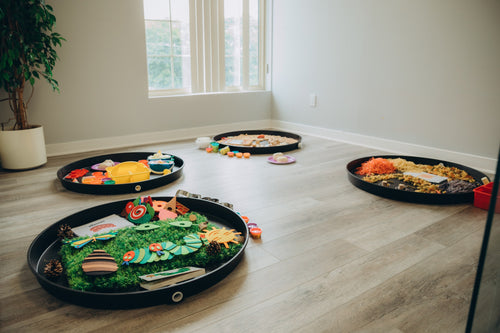
Babies aren’t passive learners. In our early education programs at Smartizen, we see this daily. They’re active explorers. They don’t need more toys. They need more meaningful inputs (rich materials) and effective opportunities (prepared environment).
Why Do Some Children Learn Easily Later — While Others Struggle?
Learning isn’t optional for babies. It’s essential.
From the very beginning, babies learn to identify:
- What’s safe
- What’s dangerous
- What’s familiar
- What brings comfort
At infant age, babies are far more easy to take in raw information and facts than when they get older. This is why babies remember experiences without effort and absorb language without drills. Their brains are designed to learn rapidly because learning increases survival. This is why babies feel overwhelmed and cranky in a crowded place because they can’t not filter out which information is useful to keep in such a busy event. But this is for another topic to discuss.
That’s also why math and literacy development for children is far easier when the brain is young. Early exposure to patterns, symbols, sounds, and meaning lays the groundwork long before formal lessons begin.
Children don’t struggle later because they started too early. They struggle because foundations were never built. Brain development does not wait until kindergarten. In fact, there are some myths about early learning and baby development you can read more!
If Babies Learn This Fast, Why Would We Wait?
Here’s the question that shifts everything:
If babies are already learning effortlessly, why wait until JK to support that process intentionally?
Waiting doesn’t protect childhood. Quite the opposite. It just delays support. It often makes learning harder later.
And early learning doesn’t steal joy. When done gently and playfully, it preserves it by making learning feel natural instead of forced later.
At Smartizen, this understanding shapes our approach. We focus on working with how the brain grows — not against it — during the years when learning feels most alive. We respect children as a human being with unmet needs and a developing brain hungry for learning that does not like to be tested.

Conclusion: Imagine a Different Beginning
Imagine a child who approaches school with curiosity instead of fear.
Who sees learning as familiar, not intimidating.
Who feels confident exploring new ideas because their brain has practiced learning for years.
That future isn’t built in kindergarten years. It’s built quietly, gently, long before.
The good news?
You don’t need to do everything.
You don’t need to start over.
You don’t need to feel behind.
You only need to begin noticing the learning that’s already happening — and choose not to waste it.
Time to take early education seriously!
If you’re curious about how to make the most of these early years — without pressure — start by observing one learning moment today. And if you’d like guidance, support, or a clearer roadmap, we’re here to help you take the next step with confidence.
We feed our babies with the best food. But we feed their brain by accident. Early learning isn’t about starting sooner. It’s about starting with intention. Waiting for JK to start training our baby just delays building a great foundation from their life. A great building is visible but we often underestimate the importance of its foundation to make such stunning architecture.
Book a program tour with our expert team at Smartizen to learn more about how we can guide you to support these early years!